
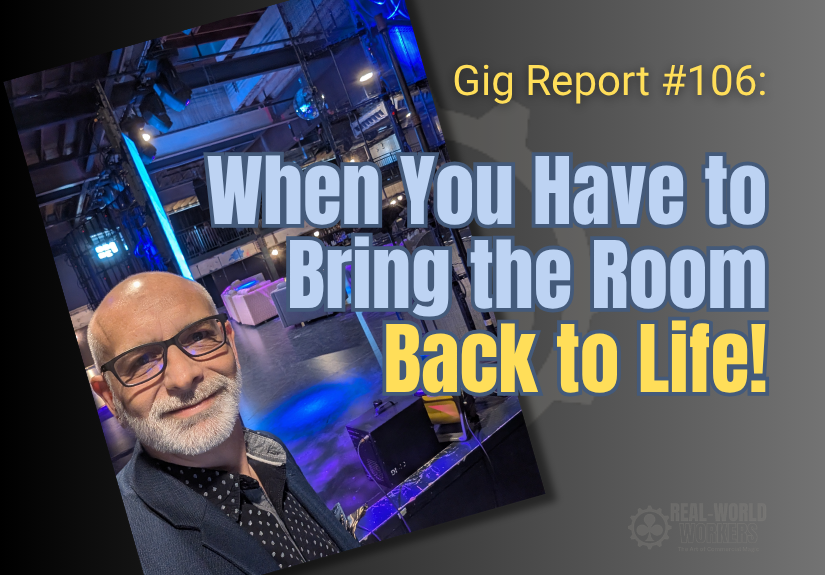
I worked a corporate event this week for a large architectural firm, and it turned into a real lesson in corporate event audience engagement.
It was their annual retreat. Full day. Panels, presentations, project breakdowns. The whole thing. People had been there since the morning, sitting through hours of what I’m sure was very important and, let’s be honest, not exactly electric content.
I was the finale. End of the day, after everything, they handed it over to me for an hour.
The venue itself was great. Big rock club downtown, full production, LED screens, the whole deal. They even had my image up on the screens, which was pretty cool. I didn’t get a single picture of it, of course, because that would make too much sense.
Corporate Event Audience Engagement in a Dead Room
The energy in the room was gone.
I got there around lunch. The keynote speaker had just finished, and from what I heard afterward, it didn’t really connect with the room. Then came another two and a half hours of panel discussions. People sitting, listening, trying to stay engaged. By the time it got to me, they were done.
You know that feeling when a room has checked out? That’s what this was.
So now it’s your turn. Big room, low energy, end of the day. That’s not a normal set. That’s a rebuild.
In a room like that, you don’t ease into it. You can’t. People talk about bringing energy, but that’s only part of it.
What Actually Brings a Room Back
It starts with being relaxed. This is where corporate event audience engagement really matters.
You can’t come out tight, rushing, trying to prove something. You have to walk out like you’ve done this before. In control. Comfortable. Some people call it gravitas. Some people call it experience. Either way, the room feels it immediately.
From there, everything runs on rhythm and pace.
Rhythm is what happens inside the material. It’s the flow within a routine. The beats, the timing, the way moments land and move into the next one. No dead spots, no awkward pauses. Just a clean sequence that keeps people engaged moment by moment.
Pace is what makes it a show. It’s how quickly you move from one thing to the next across the entire set. Fast enough that they stay with you and don’t drift, but controlled enough that they never feel lost.
When those two are working together, and you’re grounded and relaxed on top of it, the room comes back.
Why Being Real Matters
And underneath all of that, it still has to be real.
Because after a full day of people talking at them, the last thing they want is another “performance” that feels rehearsed, polished, and disconnected. They don’t need perfect. They need authenticity.
And that’s how I work.
I’m not stepping into a character up there. I’m not flipping a switch and becoming the magician. This is what I do, and this is who I am when I’m doing it. So I came out, got into strong material, and stayed completely present with them the whole time. No distance, no act, just real moments, one after the other.
And the room came back.
You could feel it. People leaning in again. Laughing again. Actually paying attention again. By the end, it was a completely different room than the one I walked into.
Afterward, a bunch of people came up and said some version of, “Thanks for saving the day.”
One person said something that stuck with me. I do a quick closing at the end. Just a minute. Nothing heavy. Just a thought about remembering the good moments. And he said, “I got more out of that one minute than the entire keynote before you.”
What Actually Matters
That’s not a knock on anybody else. It’s just a reminder.
It’s not about how long you’re on stage. It’s not even about how much energy you bring. It’s about whether people believe you while you’re there.
If it feels like a performance, they’ll sit back. If it feels real, they’ll come with you.
And sometimes, your job isn’t just to perform.
It’s to be the first real moment they’ve had all day.
Steve you’re a real pro!!! Nice job!!!
What a great article. Insights on audience management are spot on.
I love this new Trinity of performing well: relaxed, rhythm, and pace. This is genius.