
Not All Strolling Gigs Are Equal
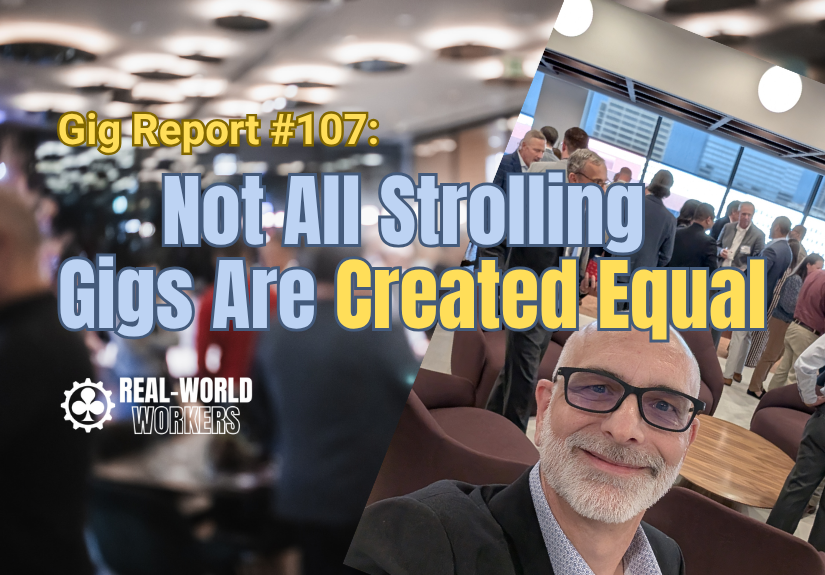
Gig Report #107: Not All Strolling Gigs Are Created Equal
A few weeks ago, I was hired to perform at a law firm that had just completed a major renovation of its offices.
Now, when most people hear “strolling gig,” they picture a wedding cocktail hour or a holiday party. People standing around with drinks, looking for something to do while they wait for dinner.
This wasn’t that.
The firm occupied an entire floor in one of those giant glass office buildings downtown. They had invested millions into the renovation and were throwing an event to show it off. Current clients were there. Prospective clients were there. Vendors, referral partners, and plenty of people I couldn’t identify but who looked important enough that somebody was making sure they had a drink in their hand.
The offices were beautiful. Everything was modern, polished, and expensive-looking. The kind of place where you feel underdressed no matter what you’re wearing.
But what struck me almost immediately was that the building wasn’t really the point.
The relationships were.
The Room Before the Magic
As I walked around, it became obvious that everybody in that room was there for a reason.
The attorneys were introducing people to each other. Clients were meeting partners. Conversations were happening in every corner of the space. Some looked social. Some looked serious. Some looked like the kind of discussions that probably involved more money than I’ve seen in my entire life.
That’s when I realized this wasn’t really a strolling magic gig in the way most people think about strolling magic.
My job wasn’t to walk into every group and start doing tricks.
In fact, that would have been the worst thing I could have done.
A lot of performers think working the room means covering as much territory as possible. Get from group to group. Do more sets. Meet more people.
Sometimes working the room means slowing down.
Sometimes it means waiting.
And sometimes it means listening.
Not because you’re being nosy. You’re simply trying to understand the environment.
Are these people catching up with old friends?
Are they talking business?
Is somebody in the middle of introducing a potential client?
Or are these four people standing in a circle desperately wishing somebody would give them something interesting to talk about?
Those situations all look similar from ten feet away.
They’re not.
Same Tricks, Different Job
The funny thing is that most magicians spend years learning tricks and very little time learning rooms.
A wedding cocktail hour has a certain rhythm.
A networking event has a certain rhythm.
A holiday party has a certain rhythm.
And a high-end law firm entertaining important clients has its own rhythm too.
The tricks don’t change much.
The job does.
At a wedding, I might walk right into a group and get things started immediately.
At an event like this, I found myself being much more selective. I’d watch a conversation for a moment. I’d wait for a natural opening. I’d let people discover me instead of forcing my way into the center of the room.
The goal wasn’t to become the event.
The goal was to contribute to it.
That’s a completely different mindset.
When the Room Finally Opens Up
A couple of hours into the evening, the atmosphere started to change.
The introductions had happened.
The business conversations loosened up.
People relaxed.
The room had settled into itself.
And suddenly the opportunities that weren’t there at the beginning of the night started showing up everywhere.
Groups began pulling me into conversations. One performance led naturally into another. People started bringing their friends over.
Then, toward the end of the evening, I found myself standing in one corner of the room with what felt like twenty-five people gathered around me.
Nobody planned it.
I certainly didn’t.
It just happened.
For a few minutes, the cocktail party disappeared and it became a show.
I ran through some of my strongest material. People were laughing, reacting, applauding. The energy built with every effect. What started as a few curious guests turned into a crowd.
And standing there, looking around at all those people, I had one thought.
If I had tried to force this moment when I first arrived, it never would have happened.
The room wasn’t ready.
The timing wasn’t right.
The opportunity didn’t exist yet.
But because I paid attention to what was actually happening, because I understood what the event was trying to accomplish, the room eventually opened up and invited me in.
When it did, I was ready.
The Real Lesson
One of the biggest mistakes magicians make is assuming that every strolling gig requires the same approach.
It doesn’t.
The props may be the same.
The material may be the same.
You may even be wearing the same suit.
But the job changes every time you walk into a new room.
Sometimes your role is to create energy.
Sometimes your role is to break the ice.
Sometimes your role is to become the center of attention for a few minutes.
And sometimes your role is to stay out of the way until the moment is right.
Not all strolling gigs are created equal.
The sooner you learn that, the better you’ll get at all of them.
This is exactly the kind of real-world performance situation we talk about in the Worker Studio Sessions. The tricks matter, but understanding the room you’re standing in matters just as much.
You can learn more about the Worker Studio Sessions here.

This topic is spot on. Every event has a distinct vibe, and finding where you fit requires patience. Once you align with the environment, navigating it becomes seamless. While “knowing the room” is the standard advice, the phrase itself lacks substance. The real takeaway here is how Steve breaks down the specific details of what knowing the room actually means.